Things To Do
Free Things To Do in Rishikesh
The Ganga Aarti, riverside walks, temples and sunsets — some of the best experiences here don’t cost a rupee.
Things To Do
Many of Rishikesh’s best experiences are completely free. Watch the Ganga Aarti, sit at the ghats, cross the iconic bridges, walk the riverbank and forest trails, visit temples (free to enter), and catch sunset over the Ganga — all for nothing. Some ashrams offer free or donation-based yoga, meditation and satsangs too. It’s one of India’s best budget destinations. This guide rounds up the best no-cost things to do, area by area.
Why Rishikesh is a budget traveller’s dream
Rishikesh is unusually generous to travellers watching their money — because so much of what makes it special is simply there, free to anyone. The sacred Ganga and its ghats, the famous pedestrian bridges, the temples, the forested hills and the nightly fire ceremony on the river cost nothing to experience. You can have a deeply moving, full and active day here without spending more than a few rupees on chai.
It helps that the town’s defining experiences are spiritual and natural rather than commercial. The Ganges is the star attraction, and it asks nothing of you but your presence. Add free or donation-based yoga and meditation at some ashrams, and Rishikesh becomes a place where a tiny budget is no barrier to a rich experience — one reason backpackers and long-stayers love it. This guide — part of the wider things to do collection — gathers the best of what you can do for free.
Free things to do at a glance
| Experience | What it is |
|---|---|
| Ganga Aarti | The nightly river fire ceremony — free & unforgettable |
| The ghats | Sit, watch rituals, dip your feet in the holy river |
| The bridges | Cross Laxman & Ram Jhula; iconic views |
| Temples | Most are free to enter and visit |
| Riverside & forest walks | Trails, waterfalls (some free) and viewpoints |
| Free / donation yoga & satsang | Offered at some ashrams |
| Sunsets & people-watching | Endless, atmospheric and free |
The sections below cover each in detail — enough to fill several days without opening your wallet.
Watch the Ganga Aarti (free)
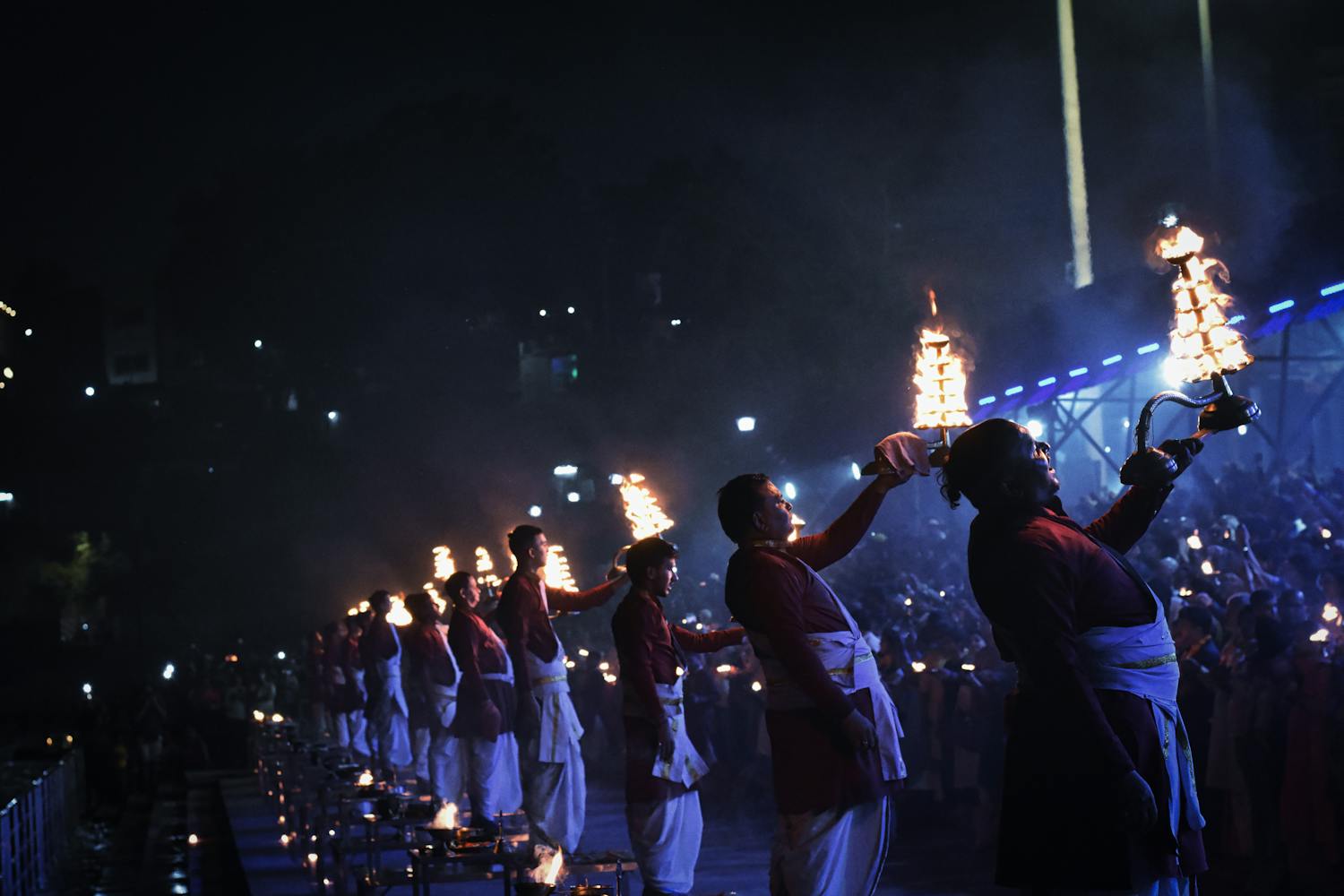
The single best free thing to do in Rishikesh is the nightly Ganga Aarti — a ceremony of lamps, chanting and firelight offered to the river at dusk. The famous version at Parmarth Niketan (near Ram Jhula), with children chanting and floating lamps, is completely free to attend, as are the aartis at Triveni Ghat and elsewhere. Arrive early for a seat on the steps, sit quietly, and let it wash over you. For many travellers it’s the most moving experience of their trip — and it costs nothing.
Sit at the ghats & by the river
The ghats — the steps leading down to the Ganga — are Rishikesh’s free living room. You can sit for hours watching pilgrims bathe, sadhus meditate, and life unfold by the holy river; dip your feet in the cold, clear water (with care for the current); or simply read, journal and soak up the atmosphere. Sunrise and sunset at the ghats are especially magical. It’s free, endlessly absorbing, and the essence of the town.
Cross the famous bridges
Walking the iconic suspension footbridges — at Laxman Jhula and Ram Jhula — is a quintessential, free Rishikesh experience, complete with river views, passing cows and monkeys, and the buzz of pilgrims and travellers. (Note the historic Laxman Jhula bridge has been closed on safety grounds, with a nearby replacement crossing in use; check locally.) The views up and down the Ganga from mid-span are superb and don’t cost a thing.
Visit the temples
Most of Rishikesh’s temples are free to enter, so temple-hopping is a rewarding no-cost way to spend a morning. See the towering Tera Manzil (Trayambakeshwar) near Laxman Jhula, Bharat Mandir in the old town, and the shrines dotted through Swarg Ashram. Remove your shoes, dress modestly, and soak up the colour, bells and devotion. Even the hilltop Neelkanth Mahadev is free to enter — only the transport costs.
Free & donation-based yoga, meditation & satsangs
You can even practise for free. Some ashrams offer free or donation-based yoga and meditation sessions, group chanting (kirtan) and satsangs (spiritual talks) open to visitors — a wonderful way to experience the town’s spiritual heart without paying school prices. Availability varies, so ask at ashrams around Ram Jhula and Swarg Ashram, and check noticeboards in cafes and guesthouses for free events, talks and kirtan nights.
Local tip: “free” at an ashram often means “by donation.” It’s gracious to give a small amount if you attend a class, satsang or aarti seating that’s offered freely — it keeps these experiences available and supports the ashram’s charitable work. Even a modest contribution is appreciated.
Walk, hike & chase waterfalls
The hills and riverbanks around Rishikesh offer free walking galore. Stroll the riverside paths between the bridges, wander the lanes of Tapovan, or hike into the forest. Some waterfalls in the surrounding hills are free or charge only a tiny entry, and the trails to them are lovely — see trekking for day-walk ideas. A sunrise walk to a viewpoint like Kunjapuri (transport aside) rewards you with Himalayan panoramas for free.
Sunsets, people-watching & atmosphere
Some of the finest free pleasures here are the simplest. Sunset over the Ganga — from a bridge, a ghat or a riverside rock — is free and unforgettable as the light turns the water and hills gold. People-watching is endlessly rich: sadhus in saffron, pilgrims performing rituals, yogis heading to class, cows ambling across the bridges. Just sitting and absorbing the colour, sound and devotion of a sacred river town is an experience in itself — and one of the things travellers remember most. Bring a journal or a book and let the hours drift.
Free things to do by area
Use the area guides to plan a free day around where you are:
| Area | Free highlights | |
|---|---|---|
| Laxman Jhula | The bridge, temples, ghats, river views, sunset | |
| Ram Jhula / Swarg Ashram | The Parmarth aarti, ashram visits, ghats, the Beatles Ashram surrounds | |
| Tapovan | Lane wandering, free/donation yoga, cafe atmosphere | rooftop views |
| Triveni Ghat / main town | The grand aarti, bathing ghats, the local bazaar buzz | |
| Surrounding hills | Forest walks, waterfalls, sunrise viewpoints |
A free day in Rishikesh
Here’s how to fill a full, rich day without spending more than a few rupees on chai:
- Sunrise — a quiet walk to the ghats or a viewpoint as the town wakes
- Morning — a free or donation yoga/meditation session at an ashram
- Late morning — temple-hopping and a wander across the bridges
- Afternoon — a riverside walk or a hike toward a waterfall; rest at the ghats
- Evening — the Ganga Aarti, then sunset and people-watching by the river
That’s a deeply satisfying day — spiritual, active and scenic — for almost nothing. Add a cheap thali and you’ve eaten well too.
Stretching your budget further
Beyond the free experiences, Rishikesh is cheap to enjoy. India’s tourism portal, Incredible India, rightly flags it as superb value, and foreign visitors usually arrive on an electronic visa via indianvisaonline.gov.in. To keep costs near zero:
- Eat local — thalis, chana and chai cost very little; see local food.
- Stay in hostels, ashrams or dharamshalas — the cheapest beds; see budget hotels.
- Walk everywhere in the core areas — no transport needed.
- Carry a reusable bottle — refill filtered water and cut plastic costs.
- Do free yoga & satsangs rather than paid drop-ins where you can.
- Travel in the off-season for the lowest prices; see the budget guide.
Related guides
- Things to do in Rishikesh — the full overview
- Hidden gems & offbeat things to do
- Ganga Aarti & famous temples — free highlights
- Budget guide — doing Rishikesh cheaply
- Hostels & local food — cheap sleeping & eating
- Areas & trip-planning hub — plan a budget trip
Free vs paid: what’s worth spending on
You can have a wonderful trip on free experiences alone, but a few paid activities are worth budgeting for if you can — they’re central to what Rishikesh offers and reasonably priced:
- River rafting — the iconic adventure; great value and hard to replicate for free.
- A yoga class or course — free sessions are limited; a few paid classes deepen the experience.
- An Ayurvedic massage or treatment — an affordable, restorative treat.
- Transport to Neelkanth or viewpoints — the sights are free; the ride is the cost (or trek for free).
Even with a few of these, Rishikesh stays cheap. The smart approach is to lean on the free experiences for the bulk of your time and spend selectively on the one or two paid activities that matter most to you.
The best things in Rishikesh really are free
There’s a deeper truth to a budget trip here: in Rishikesh, the free experiences aren’t the consolation prize — they’re often the main event. The aarti, the river, the temples, the sunrise over the hills, the simple act of sitting by the Ganga as life flows past — these are what travellers remember long after the rafting and the cafes fade. The town’s essence is spiritual and natural, and those things ask nothing of you but your time and attention.
So a tight budget is no barrier to a profound Rishikesh experience. Some of the most moved, transformed visitors are backpackers who spent almost nothing — just hours at the ghats, free meditation, and the nightly fire on the river. If anything, stripping away the spending can bring you closer to what makes the place special.
The bottom line on free things to do
Rishikesh is one of the most rewarding places in India to visit on a shoestring. The Ganga Aarti, the ghats, the bridges, the temples, riverside and forest walks, sunsets, and free or donation-based yoga and meditation can fill day after day for almost nothing — and they happen to be among the town’s very best experiences. Pair them with cheap local food and a hostel or ashram bed, spend selectively on a rafting trip or a yoga class, and you’ll have a rich, full trip on a tiny budget.
Start with the free highlights above, then explore the full things-to-do guide and hidden gems, and plan a budget trip with the budget guide and the trip-planning hub.
Free things to do by season
The free experiences are available year-round, but the season shapes them — see the best time to visit and weather guides:
- Autumn & spring (Oct–Nov, Mar–Apr) — perfect for ghats, walks, the aarti and sunrise viewpoints; clear and comfortable.
- Winter (Dec–Feb) — crisp, sunny days are lovely for temple-hopping and walks; pack a warm layer for the aarti.
- Summer (May–Jun) — hot midday, so do free walks and ghats early and late; the river is a cooling free pleasure.
- Monsoon (Jul–Sep) — lush, green and dramatic; waterfalls are full, though trails get slippery and the aarti may move undercover.
Whatever the season, the core free experiences — the river, the aarti, the temples and the atmosphere — are always there, waiting and free.
Tips for a great free day
- Start at sunrise — the ghats and viewpoints are quietest, coolest and most beautiful early.
- Plan around the aarti — build your free evening toward the river ceremony at dusk.
- Wear modest clothes & slip-on shoes — you’ll enter temples often; see the packing list.
- Carry water & a little cash — for chai and small donations; see the budget guide.
- Check noticeboards — cafes and guesthouses list free talks, kirtan and events.
- Respect the sacred — these free spaces are places of worship; tread gently and see the safety guide near the river.
Do that, and a no-cost day in Rishikesh can be every bit as memorable as an expensive one anywhere else — arguably more so, because the things you remember here were never about money in the first place.
Free experiences for every kind of traveller
The beauty of Rishikesh’s free side is that it suits everyone. Spiritual seekers can attend the aarti, sit at the ghats and join free satsangs. Nature lovers have riverside paths, forest trails and waterfalls. Culture fans can temple-hop and wander the bazaars. Photographers get the bridges, the river light and the colour of devotion. Solo travellers and backpackers find easy company and atmosphere at no cost, while couples have sunsets and quiet riverbanks. Even families can enjoy the bridges, the cows and monkeys, and the spectacle of the aarti without spending a rupee.
Whatever brought you to Rishikesh, the free experiences let you taste the real heart of the town — and often turn out to be the part you treasure most. Build your days around them, spend a little on the paid highlights that matter to you, and you’ll discover that in Rishikesh, the richest experiences are also the cheapest. Explore more in the things to do guide and plan your trip from the trip-planning hub.
Frequently asked questions
What free things can I do in Rishikesh?
Plenty. Watch the Ganga Aarti, sit at the ghats, cross the famous bridges, visit temples (free to enter), walk the riverbank and forest trails, catch sunset over the Ganga, and people-watch. Some ashrams also offer free or donation-based yoga, meditation and satsangs.
Is the Ganga Aarti free?
Yes, the Ganga Aarti is free to attend. The famous ceremony at Parmarth Niketan near Ram Jhula, with chanting and floating lamps, and the aartis at Triveni Ghat and elsewhere, are all free. Arrive early for a seat on the steps, and a small donation is appreciated but not required.
Can I do yoga for free in Rishikesh?
Sometimes, yes. Some ashrams offer free or donation-based yoga and meditation sessions and satsangs open to visitors, especially around Ram Jhula and Swarg Ashram. Availability varies, so ask at ashrams and check cafe and guesthouse noticeboards for free classes, talks and kirtan nights.
Are the temples in Rishikesh free to visit?
Yes, most temples are free to enter, including the towering Tera Manzil near Laxman Jhula, Bharat Mandir and the shrines of Swarg Ashram. Even hilltop Neelkanth Mahadev is free to enter, with only the transport costing money. Remove shoes and dress modestly when visiting.
Is Rishikesh good for budget travellers?
Excellent. Many of its best experiences, the aarti, ghats, bridges, temples, walks and sunsets, are free, and food and accommodation are very cheap. With hostels, ashrams, local thalis and free activities, you can enjoy a rich Rishikesh trip on a tiny budget.
What can I do in Rishikesh with no money?
You can fill entire days for free: a sunrise walk, a free or donation yoga session, temple-hopping, crossing the bridges, riverside and forest walks, sitting at the ghats, and the evening Ganga Aarti. Add a cheap thali and chai and you have a full, satisfying day for almost nothing.
Are the bridges free to cross?
Yes, crossing the pedestrian suspension bridges at Laxman Jhula and Ram Jhula is free and a classic Rishikesh experience, with great river views. Note the historic Laxman Jhula bridge has been closed on safety grounds, with a nearby replacement crossing in use, so check locally on arrival.
Can I see the Himalayas for free near Rishikesh?
Yes. Sunrise viewpoints in the surrounding hills, such as Kunjapuri, offer free Himalayan panoramas, with only transport costing money. Riverside and forest walks around town also give lovely views of the foothills and the Ganga valley at no cost.
Are waterfalls near Rishikesh free?
Some are free and others charge only a small entry fee. The trails to them through the forest are lovely and cost nothing, and they make a great free or near-free half-day, especially after the monsoon when the falls are full. See our trekking guide for routes.
What is the best free experience in Rishikesh?
For most visitors it is the Ganga Aarti, the nightly river fire ceremony, which is free, deeply moving and unmissable. Close behind are simply sitting at the ghats, watching sunset over the Ganga, and soaking up the atmosphere of the sacred river town.
Do I need to pay at ashrams for free events?
Many ashram classes, satsangs and aarti seatings are offered freely or by donation. While not required, it is gracious to give a small amount if you attend, as it supports the ashram and keeps these experiences available. Even a modest contribution is appreciated.
How can I keep costs down in Rishikesh?
Focus on the many free experiences, eat local thalis and chai, stay in hostels, ashrams or dharamshalas, walk everywhere in the core areas, carry a reusable water bottle, and travel in the off-season. Rishikesh is one of India’s easiest places to enjoy on very little money.
Enjoy Rishikesh for next to nothing
Discover hidden gems, see the Ganga Aarti, or plan a cheap trip with the budget guide.