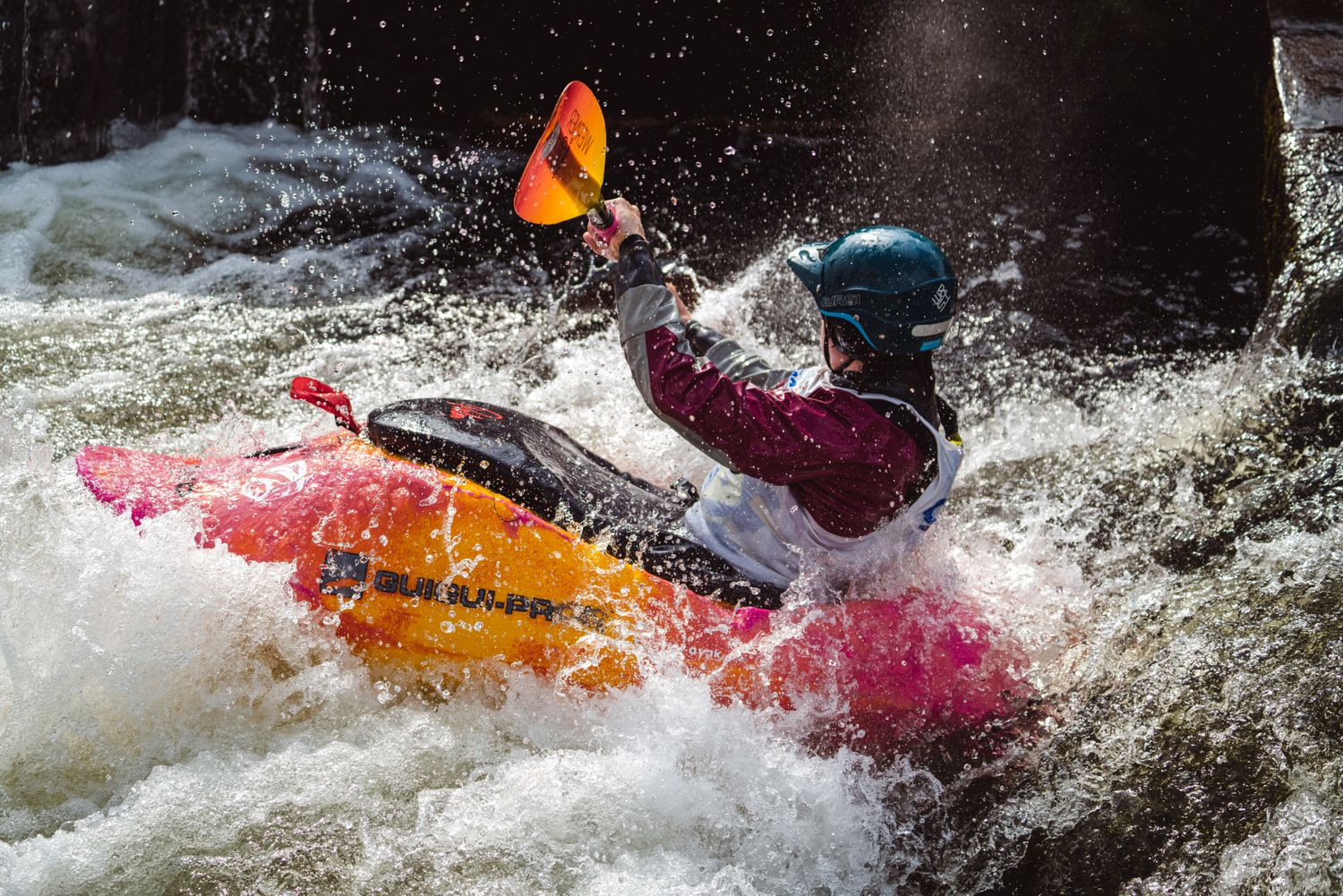
Adventure
Kayaking in Rishikesh
Learn to run the Ganga’s rapids solo — one of the world’s great places to take up the paddle.
If rafting is the Ganga’s crowd-pleaser, kayaking is its connoisseur’s choice. Where a raft carries a whole crew steered by a guide, a kayak puts you alone in a tiny boat, reading and running the rapids with your own paddle and skill. It is more demanding and more rewarding — and Rishikesh, with its warm water, road-side access and steady rapids, is one of the best places in the world to learn. This guide explains how kayaking differs from rafting, the beginner courses that take you from zero to running rapids, what it costs, the season, and how to stay safe.
Quick answer: Kayaking in Rishikesh means paddling your own one-person boat down the Ganga’s rapids — a skill sport, unlike guided rafting. Beginners start with multi-day kayak courses (often 4–7+ days) that teach paddling, rolling and river-reading, from flat water up to Class II–III rapids. Courses cost roughly ₹6,000–₹15,000+ depending on length and inclusions; you do not need experience to start a beginner clinic. Season: Sept–Jun (closed in the monsoon). Rishikesh is a renowned learn-to-kayak destination thanks to warm, accessible water.
Kayaking vs rafting: what is the difference?
Many travellers assume kayaking is just rafting in a smaller boat. It is a fundamentally different experience:
| Rafting | Kayaking | |
|---|---|---|
| Boat | Big raft, whole crew | One-person kayak |
| Control | Guide steers; you paddle on command | You alone read & run the river |
| Skill needed | None — turn up & go | Real skill — learned over days |
| Learning curve | Instant | Days to weeks |
| Best for | A one-off thrill | A skill to own & progress |
In short: choose rafting for an instant group adventure, and kayaking if you want to genuinely learn a sport and have the river to yourself. Our rafting vs kayaking guide compares them in full.
Why learn to kayak in Rishikesh?
Rishikesh has quietly become one of the world’s great beginner-kayaking destinations, and for good reasons. The upper Ganga offers a rare combination: warm water (far kinder for the inevitable capsizes than cold European or American rivers), a road running alongside the river for easy access and safety support, and a steady, predictable series of rapids that build naturally from gentle to challenging. Add long sunny seasons, affordable instruction and a community of international paddlers, and you have an ideal learning environment.
For complete beginners especially, that warm, accessible water makes a huge difference — learning to roll a kayak (righting yourself after capsizing) is far less daunting when the water is pleasant and help is close.
How beginners learn: kayak courses
You do not just rent a kayak and jump into rapids — kayaking is learned progressively through a structured course, usually over several days. A typical beginner course arc:
- Flat water first: basic strokes, balance, and getting comfortable in the boat on calm water.
- The wet exit & the roll: learning to escape a capsized kayak safely, then to “roll” it back upright — the core survival skill.
- Easy moving water: ferrying across current, catching eddies, reading the river.
- Gentle rapids (Class II): applying your skills on real but forgiving whitewater.
- Progression to Class III as your confidence and roll become reliable.
Courses commonly run 4 to 7+ days; the longer you give it, the more independent you become. Shorter “taster” sessions exist but a few days is the realistic minimum to actually paddle whitewater.
💡 Tip: The roll is the make-or-break skill and the most frustrating to learn — expect to swallow some Ganga before it clicks. Stick with it; the moment your first reliable roll lands is when kayaking truly opens up.
A day on a kayak course
To demystify it, here is what a typical day on a beginner course looks like once you are past the first flat-water session:
- Morning warm-up & theory: a briefing on the day’s skills and the stretch of river you will paddle, plus stretching.
- Skills practice on calm water: rehearsing strokes, edging and rolls in an eddy or calm pool before committing to current.
- Guided river time: paddling a gentle section with your instructor, practising catching eddies and ferrying across the flow.
- Rapid runs: as you progress, running short rapids one at a time with the instructor positioned for safety below.
- Roll practice: ending many sessions with deliberate capsize-and-roll repetitions — repetition is what makes the roll reliable.
- Debrief: reviewing what went well and what to work on next.
Days are active but not exhausting, with plenty of rest between runs. Over a week these building blocks compound quickly — paddlers who could barely balance on day one are often running Class II–III rapids by the end.
Beyond beginner: clinics & expeditions
- Intermediate clinics — refine your roll, run bigger rapids, learn rescue skills.
- Multi-day river trips — once competent, paddle longer Ganga sections and other Himalayan rivers.
- Freestyle / play boating — surfing standing waves and play features for the tricks-focused.
- Expedition kayaking — experienced paddlers use Rishikesh as a base for Himalayan river expeditions.
Rishikesh’s kayaking scene supports the whole journey from first paddle to expedition, which is part of why paddlers return year after year.
Understanding the rapids
Beginners learn on Class I–II water and progress toward Class III as skills allow — the same internationally recognised scale used for rafting. In a kayak, though, a Class III feels far bigger than from a raft: you are at water level, in full control and fully responsible. For reference on the grading system and safety conventions, see the international whitewater safety standards. Progress is about skill and judgement, not bravado — good instructors hold you at each grade until your roll and river-reading are solid.
The mental side of learning to kayak
Kayaking is as much a head game as a physical one, and knowing that in advance helps enormously. The single biggest hurdle for beginners is not strength or fitness — it is staying calm when upside down underwater. Your instinct on capsizing is to panic and bail out; learning to pause, set up and roll instead is a genuine exercise in composure under stress.
This is also exactly why so many people find kayaking deeply rewarding, and why it sits so naturally in Rishikesh alongside yoga and meditation. It demands presence: on a rapid there is no room for a wandering mind, only breath, focus and response. Many paddlers describe the same flow-state calm they find on the mat. Embrace the capsizes as practice rather than failure, breathe, and trust the progression — the mental steadiness you build transfers far beyond the river.
💡 Tip: If being underwater unsettles you, spend time beforehand simply getting comfortable holding your breath and relaxing below the surface. Calm underwater is the single most useful thing you can bring to your first lesson.
What does kayaking cost?
- Beginner multi-day course (4–7 days): ~₹6,000–₹15,000+ depending on length, group size and inclusions
- Single instruction session / taster: ~₹1,500–₹3,000
- Equipment rental (experienced paddlers): varies; often bundled into courses
- Intermediate clinics & trips: priced per programme
Courses usually include the kayak, paddle, spray deck, helmet, life jacket and instruction; some bundle accommodation and meals. Confirm exactly what is covered. See our budget guide to plan overall spend.
When to kayak: season
Kayaking follows the river season — roughly September to June, closed in the monsoon (July–August) when the Ganga is too high and powerful. Within the season:
- Sept–Nov: excellent — settled water, warm air, ideal for learning.
- Dec–Feb: cooler water (a wetsuit helps) but runnable and quiet.
- Mar–Jun: warm and popular; higher early-season flows then easing.
See best time for rafting (the same river window applies) and best time to visit.
Is kayaking safe? Honest guidance
Whitewater kayaking is an inherently more advanced and committing activity than rafting — you are solo and self-reliant — but learned properly, in a structured course with good instructors, it is managed and progressive, not reckless. Key safety points:
- Learn with qualified instructors — never teach yourself rapids from videos.
- Master the roll and wet exit before progressing to harder water — they are your safety net.
- Always wear a helmet and life jacket — provided and non-negotiable.
- Progress within your level — do not run rapids beyond your reliable skill.
- Warm water helps, but respect the river — the Ganga is powerful; never paddle alone as a beginner.
- Be a competent swimmer and comfortable underwater — capsizing is part of learning.
See our Rishikesh safety guide for broader advice.
Not sure about a kayak? Gentler alternatives
Kayaking is a commitment — if it sounds like more than you want, the Ganga offers gentler ways onto the water:
- Rafting — the obvious one: all the rapids, none of the skill curve, guided the whole way. See river rafting.
- Stand-up paddleboarding (SUP) — some operators offer flat-water SUP on calm Ganga stretches, a serene way to be on the river without whitewater.
- A single kayak taster session — if you are merely curious, a one-off lesson on calm water lets you try it before committing to a full course.
- Body surfing & river swimming — often included on rafting trips, a fun way to feel the river safely.
There is no shame in choosing a gentler option — the river is wonderful at every level. Kayaking simply rewards those who want to invest the time to truly master it.
Who is kayaking for?
| Traveller type | Recommendation |
|---|---|
| Wants a one-off thrill | Choose rafting instead — instant, no skill needed. |
| Wants to learn a skill | A beginner kayak course — exactly what Rishikesh excels at. |
| Slow traveller / long stay | Ideal — spend a week truly learning to paddle; see our slow-travel guide. |
| Experienced paddler | Clinics, play boating and Himalayan river trips. |
| Non-swimmer | Not suitable — start with rafting; learn to swim first. |
| Solo female traveller | Very doable; join a reputable course — see our solo guide. |
How to choose a kayak school
Because kayaking is a safety-critical, instruction-led sport, the school matters even more than for rafting. A few things to look for before you book a course:
- Qualified, experienced instructors — ideally with recognised paddlesport coaching credentials and years on the Ganga, not just keen paddlers.
- A low instructor-to-student ratio — small groups mean more water time, faster progress and closer safety cover.
- A clear, progressive course structure — flat water to roll to rapids, with realistic day-by-day goals rather than a vague “we will see how you go.”
- Good, well-maintained equipment — properly sized boats, helmets, spray decks and buoyancy aids in good condition.
- Strong safety culture — instructors positioned for rescue, clear briefings, and a willingness to hold you at a grade until you are ready.
- Genuine recent reviews from beginners, ideally mentioning how supported and safe they felt while learning.
Many of Rishikesh’s kayak schools are run by passionate paddlers with deep river knowledge, which is a real asset — just confirm the coaching and safety basics rather than booking on enthusiasm alone. The vetting mindset in our how to choose a school guide applies to kayaking too.
Common mistakes
- Expecting to kayak rapids on day one — it is a progressive skill; respect the course.
- Skipping the roll — it is the foundation; do not rush past it.
- Booking a taster when you wanted to learn — give it several days to actually paddle whitewater.
- Confusing it with rafting — if you just want a guided thrill, raft instead.
- Paddling alone as a beginner — always with instructors or a group.
- Kayaking in the monsoon — the river is closed for safety.
Local tips you should know
- Commit to a multi-day course if you genuinely want to learn — it is the only way to reach real rapids.
- Be comfortable in water beforehand; practise breath-holding and staying calm if it helps.
- Many courses cluster around Shivpuri and the rafting stretches; some bundle accommodation.
- Pair kayaking with camping for a riverside skills week.
- Bring or rent quick-dry kit; a wetsuit is worth it in cooler months.
- Apply for your tourist e-Visa early; see how to reach Rishikesh.
Related adventures & nearby
- River rafting — the guided alternative.
- Rafting vs kayaking — which suits you.
- Camping — base yourself by the river.
- Shivpuri area guide — the adventure hub.
- All adventure in Rishikesh — the full hub.
Frequently asked questions
What is the difference between kayaking and rafting?
Rafting uses a large raft steered by a guide with a whole crew and needs no skill. Kayaking puts you alone in a one-person boat, reading and running the rapids yourself — a real skill learned over several days. Choose rafting for an instant thrill, kayaking to learn a sport.
Can beginners learn to kayak in Rishikesh?
Yes — Rishikesh is one of the best places in the world to learn, thanks to warm water, road-side access and progressive rapids. Beginner courses take you from flat water to running gentle rapids over several days.
How long does it take to learn kayaking?
Beginner courses typically run 4 to 7 or more days. A few days is the realistic minimum to learn the roll and paddle easy whitewater; the longer you train, the more independent you become.
How much does a kayaking course cost in Rishikesh?
A multi-day beginner course runs roughly ₹6,000–₹15,000+ depending on length, group size and inclusions. Shorter taster sessions cost about ₹1,500–₹3,000.
Do I need to know how to swim to kayak?
Yes. Unlike rafting, kayaking requires you to be a competent swimmer and comfortable underwater, because capsizing and wet exits are part of learning. Non-swimmers should start with rafting.
What is a kayak roll?
The roll is the technique of righting a capsized kayak without leaving the boat, by using a paddle stroke and hip movement. It is the core safety skill every kayaker learns, and the foundation for running harder rapids confidently.
When is the kayaking season in Rishikesh?
Roughly September to June. Kayaking closes during the monsoon (July–August) when the Ganga is too high and powerful to be safe.
What grade of rapids will I kayak?
Beginners learn on Class I–II water and progress toward Class III as their skills develop. In a kayak, a Class III feels much bigger than from a raft because you are solo and at water level.
Is kayaking safe in Rishikesh?
Learned properly in a structured course with qualified instructors, yes. It is more advanced than rafting, so master the roll and wet exit, always wear a helmet and life jacket, progress within your level, and never paddle alone as a beginner.
Why is Rishikesh good for learning to kayak?
The upper Ganga combines warm water (kinder for capsizes), a road alongside the river for access and safety, and steady, progressive rapids — plus affordable instruction and an international paddling community.
What should I bring for a kayak course?
Quick-dry clothing or swimwear, secure footwear, sun protection, and a towel and dry clothes. A wetsuit helps in cooler months. Courses provide the kayak, paddle, spray deck, helmet and life jacket.
Can experienced kayakers find advanced paddling?
Yes — Rishikesh supports intermediate clinics, freestyle play boating, longer river trips and Himalayan expeditions, making it a base for paddlers at every level, not just beginners.
Ready to take up the paddle?
Kayaking is the adventure you take home as a skill, not just a memory — and Rishikesh is the perfect place to start. Commit to a course, embrace the capsizes, and learn to read the river. These guides will help:
- Rafting vs kayaking — decide which is for you
- River rafting — the guided alternative
- Camping — a riverside base for your week
- Rishikesh for backpackers — plan a budget adventure stay