Wellness
Sound Healing in Rishikesh
The easiest way into stillness — lie back as singing bowls and gongs do the rest.
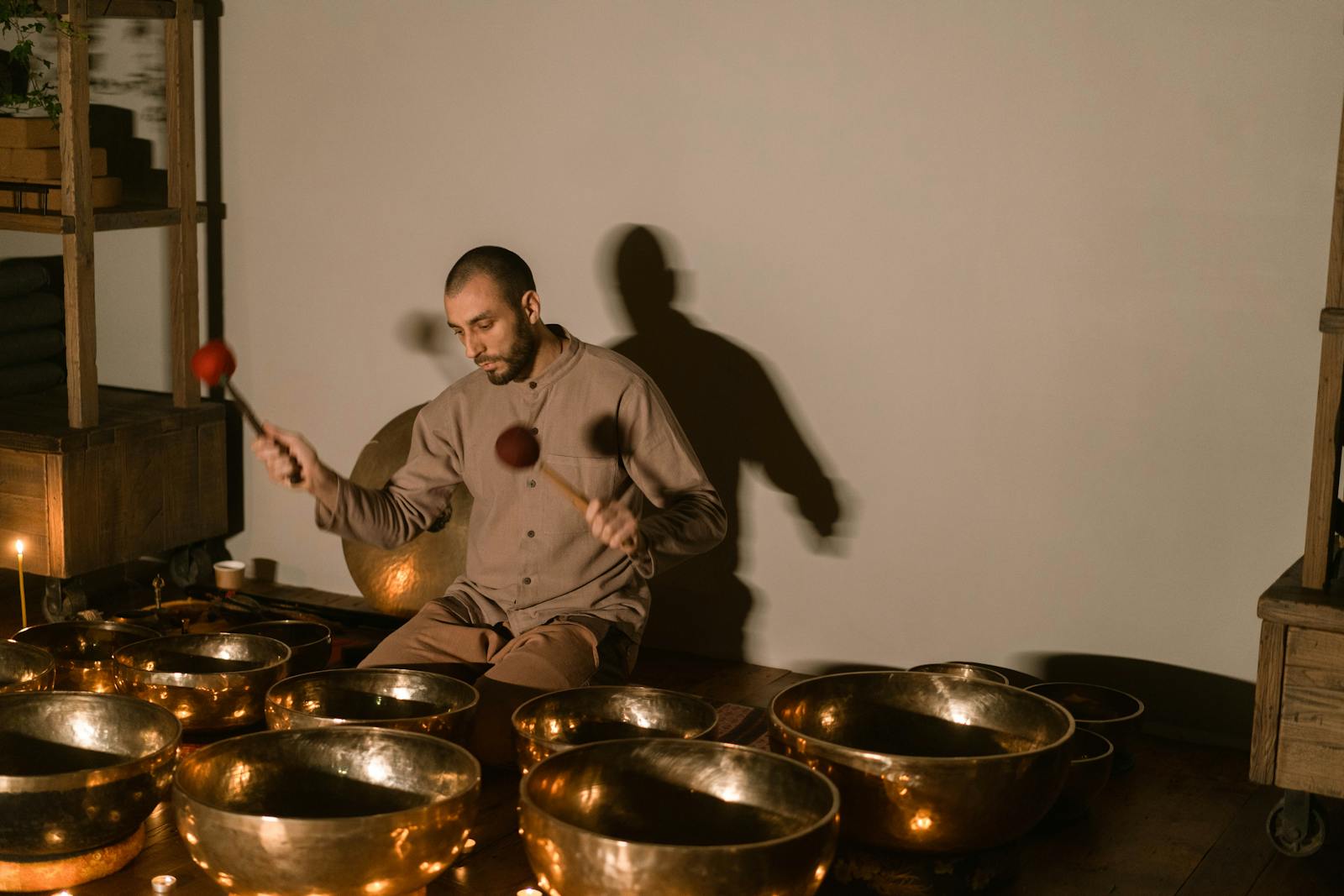
Lie down, close your eyes, and let waves of sound from singing bowls, gongs and chimes wash over you for an hour — that, in essence, is a sound healing session, and it has become one of Rishikesh’s most popular wellness experiences. Also called a sound bath, it is one of the gentlest, most accessible ways into deep relaxation and meditation: there is nothing to learn, nothing to “get right,” and no experience required. This guide explains what sound healing actually is, the instruments used, what a session feels like, an honest take on the benefits, what it costs, and how to choose a good practitioner.
Quick answer: Sound healing in Rishikesh is a deeply relaxing session where you lie down while a practitioner plays Tibetan/Himalayan singing bowls, gongs, chimes and voice to guide you into a meditative state. Sessions last 45–75 minutes and cost roughly ₹500–₹2,000 for a group session, more for private. No experience needed — you simply lie back and listen. It pairs beautifully with meditation and yoga. Available year-round; best months to visit are Sept–Nov and Feb–Apr.
Is sound healing for you?
If the idea of meditation appeals but sitting still and “clearing your mind” feels impossible, sound healing was practically made for you. It delivers much of what meditation offers — a calmer mind, deep rest, a break from mental noise — with none of the effort or learning curve. It is equally suited to seasoned meditators who simply enjoy being carried somewhere deep, to stressed travellers who need to decompress, and to curious sceptics who just want a genuinely relaxing hour.
It asks nothing of your fitness, flexibility, beliefs or experience. The only people who should take a little care are those with epilepsy, who are pregnant, or who have specific conditions affected by deep vibration — a quick word with the practitioner beforehand covers it. For almost everyone else, the worst case is a very pleasant nap, and the best case is the deepest relaxation you have felt in months.
What is sound healing?
Sound healing is the use of sound and vibration to promote deep relaxation and a meditative state. In a typical “sound bath,” you lie comfortably on a mat while a practitioner plays a sequence of resonant instruments around the room. The continuous, overlapping tones give the busy mind something simple to rest on, helping it slow down and let go — much as a guided meditation does, but without any effort on your part.
Its roots run deep: chanting, mantra and the sacred syllable Om have been used in the yogic and Vedic traditions for millennia, and Himalayan singing bowls have a long history across the region. In Rishikesh — where these traditions are alive — sound healing sits naturally alongside yoga and meditation, and many travellers find it the easiest possible entry point to stillness.
Why experience sound healing in Rishikesh?
Sound baths are offered in wellness studios all over the world now, but Rishikesh has a particular authenticity and abundance. Sound has been part of the spiritual life here for centuries — in temple bells, the chanting of mantras, the nightly Ganga Aarti, and the constant murmur of the river itself. Practitioners here often come from genuine yogic and musical backgrounds rather than weekend certifications, and many trained in the Himalayan singing-bowl tradition directly.
There is also sheer availability and value. Group sound baths run almost nightly somewhere in Tapovan and along the river, frequently for the price of a coffee back home, and they slot naturally around your yoga and meditation practice. Experiencing a sound bath beside the Ganga, with the foothills around you, simply lands differently than the same session in a city studio — the setting amplifies the stillness.
The instruments of a sound bath
Tibetan / Himalayan singing bowls
The signature instrument — metal bowls that produce rich, sustained tones when struck or rimmed. Often placed on or around the body so you feel the vibration as much as hear it.
Crystal singing bowls
Made of quartz, these produce purer, more piercing tones often associated with specific notes and chakras. Their clear, glassy sound is unmistakable.
Gongs
Large gongs create immersive walls of sound rich in overtones — the most powerful, enveloping part of many sessions, sometimes called a “gong bath.”
Voice, mantra & chimes
Many practitioners weave in chanting, mantra, koshi chimes, tuning forks, the tanpura drone, and even the breath — layering textures to deepen the experience.
What a session actually feels like
You arrive, settle onto a mat with a blanket and bolster, and get comfortable lying down — warmth and comfort matter, because you may not move for an hour. The practitioner begins gently, often with a short breathing exercise or intention-setting, then builds layers of sound. There is no “doing”: you simply listen and let the tones carry you.
Most people drift into a dreamy, between-waking-and-sleep state. Common experiences include physical tingling from the vibrations, a profound sense of heaviness or floating, vivid imagery, emotional release, or simply the deepest rest they have had in weeks. Occasionally people fall asleep — that is fine. The session usually closes with a few minutes of silence and a gentle return.
💡 Tip: There is no “right” experience. Some feel waves of bliss, others mainly notice deep relaxation, and a few feel restless at first. Let go of expectations and simply allow whatever happens — that openness is the whole practice.
An honest take on the benefits
Sound healing has genuine, widely reported benefits — and it is worth being clear-eyed about what they are. What people reliably experience is deep relaxation and stress relief: the practice reliably calms the nervous system, much like meditation, and that alone is valuable. Reported benefits include:
- Reduced stress and a calmer, quieter mind
- Deep relaxation and relief from mental over-stimulation
- Better sleep, especially after evening sessions
- A meditative state that is far easier to reach than seated meditation
- Emotional release and a sense of lightness afterward
What sound healing is not is a substitute for medical treatment. Claims that specific frequencies “cure” diseases or “repair DNA” go well beyond the evidence. The honest framing — and the one good practitioners use — is that sound healing is a powerful relaxation and meditation aid, and relaxation has real, well-documented effects on stress, sleep and wellbeing. General wellbeing benefits of relaxation and stress reduction are recognised by health bodies such as the NHS. Approach it for what it genuinely delivers — rest and calm — rather than miracle cures.
The idea behind it: resonance & the nervous system
You do not need to believe anything mystical for sound healing to work — the most grounded explanation is also the simplest. Sustained, gentle, predictable sound gives an overactive mind a single, undemanding thing to rest on. As attention settles, the body shifts out of the stressed “fight-or-flight” state and into the “rest-and-digest” response, where the heart rate slows, muscles soften and the breath deepens. That physiological shift — not magic frequencies — is where the real benefits of relaxation come from.
The instruments help because their rich, overlapping overtones are continuous and non-threatening; there is no sharp beginning or end to grab the mind and pull it into thought. You also feel low-frequency vibration physically, especially with bowls placed near the body, which adds a soothing tactile anchor. Some practitioners talk about “entrainment” — the tendency of rhythms to sync — and chakra-specific frequencies; these ideas are part of the tradition but not well established scientifically. The dependable, evidence-aligned mechanism is straightforward: deep relaxation, reliably induced. That is plenty.
💡 Tip: If a practitioner makes strong medical claims (curing illness, “tuning your cells”), gently lower your expectations of those claims — but you can still fully enjoy the session for the deep rest it genuinely provides.
Types of sound healing in Rishikesh
- Group sound baths — the most common and affordable; a room of people lying down together, often offered daily at yoga schools and cafes.
- Private sessions — one-to-one, with the practitioner able to place bowls on the body and tailor the session; more expensive but more personal.
- Sound healing within yoga classes — a short bath during the final relaxation (savasana) of a yoga session.
- Sound healing teacher trainings — multi-day or multi-week courses for those who want to learn to facilitate; Rishikesh offers many.
- Combined with meditation or breathwork — sessions that blend sound with meditation or pranayama.
What does sound healing cost?
- Group sound bath: ~₹500–₹2,000 per session
- Private session: ~₹2,000–₹5,000+ depending on length and practitioner
- Within a yoga class: often included in the class price
- Sound healing course / training: varies widely by length — ask for an itemised quote
Sound healing is one of the more affordable wellness experiences in Rishikesh — see our yoga & wellness costs guide to budget the whole trip.
Who is sound healing for?
| Traveller type | Recommendation |
|---|---|
| Total beginner to wellness | Ideal first step — nothing to learn; just lie down and receive. |
| Can’t “sit” to meditate | Perfect — a passive route to a meditative state; pairs with meditation. |
| Stressed / poor sleep | Excellent for deep relaxation; try an evening session. |
| Yoga retreat guest | A lovely add-on; many retreats include it. |
| Curious sceptic | Try a low-cost group session with realistic expectations — enjoy the rest. |
| Solo female traveller | Group sessions are very comfortable; choose an established venue — see our solo female guide. |
How to choose a sound healing session
- Group for a first try — cheaper and lower-pressure; go private once you know you love it.
- Check the practitioner’s experience and read recent reviews.
- Look at the instruments — a varied set (bowls, gongs, chimes) usually makes for a richer session.
- Mind the setting — a calm, comfortable, warm space matters when you are lying still for an hour.
- Be wary of grand medical claims — honest practitioners promise relaxation, not cures.
- Evening sessions are great for sleep; morning ones for a calm start.
Sound healing vs meditation vs yoga nidra
Travellers often ask how sound healing compares to the other deep-rest practices on offer in Rishikesh. They overlap, but each asks something different of you. Seated meditation is active and effortful — you train attention yourself — which is powerful but hard for restless beginners. Sound healing is the opposite: entirely passive, the sound does the guiding, so it is the easiest entry point and ideal for people who “can’t switch off.” Yoga nidra (“yogic sleep”), often taught at yoga schools, sits in between — a guided body-scan relaxation that, like a sound bath, you simply lie back and receive, but led by a voice rather than instruments.
None is “better” — they are complementary. A common and lovely rhythm in Rishikesh is gentle yoga in the morning, seated meditation when the mind is fresh, and an evening sound bath or yoga nidra to dissolve the day. If you are new to all of it, start with sound healing: it asks nothing of you and gives you a felt taste of the stillness the other practices build toward.
Common mistakes
- Expecting a cure — come for deep relaxation, not miracles.
- Arriving cold or uncomfortable — bring a layer; you will be still for an hour.
- Fighting the experience — there is no right way to feel; let go.
- Eating a heavy meal first — lying down full is uncomfortable; eat light beforehand.
- Choosing purely on price — the practitioner and space matter more than a few rupees.
Local tips you should know
- Many yoga schools and cafes in Tapovan offer regular evening sound baths — easy to drop into.
- Pair it with meditation or a yoga class for a complete wind-down.
- Wear loose, warm, comfortable clothing and bring socks — body temperature drops when you lie still.
- Arrive a few minutes early to settle; latecomers disrupt the group.
- Apply for your tourist e-Visa in advance if visiting from abroad.
- See how to reach Rishikesh to plan your trip.
How to get the most from a session
A little preparation turns a pleasant hour into a genuinely deep reset:
- Eat lightly beforehand — lying down on a full stomach is uncomfortable and pulls focus.
- Hydrate before and after — many people feel thirsty afterward.
- Arrive a little early to settle, use the bathroom, and get comfortable before it starts.
- Dress in warm layers and bring socks — your body cools as it relaxes for an hour.
- Set a loose intention — simply “to rest” or “to let go” is enough; it gives the mind permission to switch off.
- Let go of the outcome — do not chase a particular feeling. Whatever arises, including restlessness or sleep, is fine.
- Leave gentle time afterward — avoid rushing straight into a busy plan; let the calm linger.
Most importantly, give yourself permission to do absolutely nothing for the duration. In a culture of constant doing, an hour of receptive stillness is itself the medicine — the bowls just make it easy to surrender to.
Related guides & nearby
- Meditation in Rishikesh — the natural companion practice.
- Ayurveda — pair with a wellness reset.
- 7-day yoga retreats — many include sound healing.
- Ganga Aarti — another deeply resonant, sound-rich experience.
- Rishikesh for yoga travellers — the full planning hub.
Frequently asked questions
What is sound healing?
Sound healing (or a sound bath) is a relaxation practice in which you lie down and listen as a practitioner plays resonant instruments — singing bowls, gongs, chimes and voice — to guide you into a calm, meditative state.
Do I need any experience for sound healing?
None at all. You simply lie down, close your eyes and listen. There is nothing to learn or do, which makes it one of the most accessible wellness experiences.
How long is a sound healing session?
Most sessions run 45 to 75 minutes, including a short settling-in and a few minutes of silence at the end.
How much does sound healing cost in Rishikesh?
Group sound baths typically cost ₹500–₹2,000, while private sessions run ₹2,000–₹5,000+ depending on length and practitioner. It is one of Rishikesh’s more affordable wellness experiences.
What instruments are used?
Commonly Tibetan/Himalayan singing bowls, crystal singing bowls, gongs, koshi chimes, tuning forks, the tanpura drone, and the practitioner’s voice and mantra.
What does a sound bath feel like?
Most people enter a dreamy, deeply relaxed state between waking and sleep, sometimes with physical tingling, a sense of floating or heaviness, vivid imagery or emotional release. Some fall asleep — that is fine.
Does sound healing really work?
It reliably produces deep relaxation and stress relief, much like meditation, and many report better sleep and calm. It should be understood as a relaxation and meditation aid, not a medical treatment or cure.
Is sound healing the same as meditation?
They are closely related. Sound healing is a passive, sound-guided route into a meditative state, making it ideal for people who find seated meditation difficult.
What should I wear and bring?
Loose, warm, comfortable clothing and socks — body temperature drops when you lie still. Venues usually provide mats, blankets and bolsters.
Is sound healing safe?
For most people, yes — it is gentle and non-invasive. If you have epilepsy, are pregnant, or have specific health concerns, mention them to the practitioner beforehand, as deep vibration and certain sounds may not suit everyone.
Can I combine sound healing with yoga or meditation?
Yes — it pairs beautifully. Many yoga classes end with a short sound bath during savasana, and combining it with meditation deepens both.
Where can I find sound healing in Rishikesh?
Many yoga schools, wellness centres and cafes — especially around Tapovan — offer regular group sound baths, often in the evening, plus private sessions on request.
Ready to lie back and listen?
Sound healing is the easiest first step into Rishikesh’s world of stillness — no skill, no effort, just deep rest. Start with a group session and see where it takes you. These guides will help:
- Meditation in Rishikesh — the companion practice
- Ayurveda — deepen your wellness reset
- 7-day yoga retreats — often include sound healing
- Rishikesh for yoga travellers — plan the whole trip